Saturday, May 22, 2010

Dell Aero aka Mini 3i coming to India?

0 comments
Dell today during an earnings conference call with journalists, announced that it will be launching a smartphone in India. This smartphone will be launched in the later part of 2010, and we are expecting this to be Dell Mini 3i aka Dell Aero.
Android based Dell Aero is going to be available in United States with AT&T soon, while it was launched in Brazil and China earlier this year. This is the lone smartphone from Dell to date, which several other phones are in pipeline.
Dell Aero
Talking about the specs of Dell Aero, it comes with Android 1.5 (may see Android 2.1 update on release), 624MHz Marvell processor, a 3.5-inch capacitive multitouch screen with other standards features.

Tata Docomo launches its GSM services in Ahmadabad

0 comments

On Thursday, the Tata Docomo, GSM Mobile service of Tata Teleservices (TTSL) announced to launch its GSM Mobile service network in Ahmadabad, Gujarat.

The company also launched its foremost Dive-in Store in city that can provide latest products and service offerings of Tata DOCOMO. The store incorporates unique VAS kiosks which enables faster access to users.

Mr.Nipun Sharma, Chief Operating Officer, Gujarat, Tata DOCOMO, said “We had made a promise at the time of the launch of our services that we would connect the length and breadth of Gujarat and bring in products and services that would redefine the telecom experience,”

He added, “Keeping in view the century of trust associated with the house of Tatas, we are launching the concept of fare being fair.”

The company that has already expanded its services in 16 Circles including Tamil Nadu, Kerala, Orissa, Karnataka, Andhra Pradesh, Mumbai, Rest of Maharashtra and Goa, Madhya Pradesh-Chhattisgarh, Haryana, Kolkata, Rest of West Bengal, Jharkhand-Bihar, Punjab, UP (East), UP (West) and Gujarat telecom Circles will soon launch its services in Rajasthan as well.

Lemon Mobiles unveils its latest Opera Mini based iQ 707 mobile in India

0 comments

Lemon mobiles unwraps its latest Smartphone iQ 707 that enables easy access to internet due to its support to Opera Mini browser.

This new Lemon handset features a QWERTY keyboard with a 2.2 inch wide display screen. iQ 707 flaunts with its support to Java, quadband, EDGE and a trackball. Opera Mini Web integrated with the phone offers server-side compression that speeds up the browsing experience for its users.

Speaking about the inclusion of Opera Mini in iQ 707, Dag Olav Norem, VP Products, Opera Software quoted, “India has been one of our fastest-growing markets over the past few years. Today, it represents our third-largest Opera Mini user base, after Russia and Indonesia. With the rapid rise in the number of people browsing the Web from their mobile phones, users are picking only the best software for their devices—and that is Opera Mini.”

This phone also features 3.2 MP camera, MP3 player, video recorder, FM, voice recorder, Bluetooth, GPRS/WAP, torch, alarm, world clock, calculator, stopwatch and magic shaker. Besides the browser, the phone also supports the Nimbuzz Instant messengers. iQ has internal memory of 20MB that can be expanded up to 8GB.

The pricing and availability details are yet to be revealed by the company.

Wynn Telecom Limited unveils its seven latest Dual Sim handsets in India

0 comments

Today Wynn Telecom Limited introduced its latest range of affordable mobile phones in Mumbai. These handsets incorporates features such as large LCD display, dual SIM, expandable memory up to 8GB, Bluetooth, and torch light.

The complete range supports high efficiency battery, amazing looks with multiple languages. The phones also feature camera, video player, wireless FM and expandable memory. Thus these mobile phones integrate features of Utility, multimedia and QWERTY phones.

Rakesh Malhotra, Founder and Chairman, Wynn Telecom Ltd said, “Consumer response to quality Indian brands has been overwhelming in the last 12 months which has encouraged well entrenched and reputed consumer brands like us to make significant investments in this space to secure long term leadership in this domain.”

The latest Y-50 QWERTY mobile phone incorporates pre-loaded AIO Messenger, social networking applications and multimedia.

Wynncom claims that it is the foremost brand of mobile phones to produce its products simultaneously through a PAN India network of 400+ distributors and 25,000 retail counters.

These new mobile phones will range between Rs. 1,500 and Rs. 5,000.


India 3G spectrum bid results

0 comments

At the closer of the India’s 3G auctions, most of bidders including the biggies Bharti Airtel, Vodafone and Reliance Communications emerging winners for the 3G airwaves. While latest entrant in GSM arena Videocon Telecommunications Ltd and Etisalat DB were unable to win a single circle.

The GSM biggies Vodafone Essar, Bharti Airtel and dual technology operator Reliance Communications (Rcom) bagged the lucrative Delhi and Mumbai circles for a whopping Rs.3316.93 crore & Rs 3247.07 crore respectively and hope to get good 3G subscriber base initially with the commercial launch in both circles.

India’s largest GSM service provider Bharti Airtel, which had pan-India 3G ambitions, had to settle for just for 13 telecom circles along with Reliance Communications and Aircel. The company said in a statement “We would like to point out that the auction format and severe spectrum shortage along with ensuing policy uncertainty, drove the prices beyond reasonable levels. As a result, we could not achieve our objective of pan India 3G footprint in this round.”

Bharti Airtel has emerged successful in Delhi-NCR, Mumbai, Andhra Pradesh, Karnataka, Tamil Nadu (including Chennai service area), UP West, Rajasthan, West Bengal, Himachal Pradesh, Bihar, Assam, North East and Jammu & Kashmir.

Another Pan-India operator Aircel emerged as the biggest spender which bagged 3G license for its strong hold areas and covers almost South and East region of the country. Aircel has the same number of telecom circles for 3G services as Bharti Airtel. But at very lower financial outflow compare to Airtel, it is paying almost half the price that Bharti Airtel is.

Mr. Gurdeep Singh, COO, Aircel said to TelecomTalk “After several rounds of competitive bidding, Aircel has bagged 13 telecom circles in 3G for Rs. 6500 crores which will allow us to take our Data Strategy to the next level. This further opens new revenue opportunities and gives way to a dynamic Business Model.”

He also added “We now cover the whole of Southern and Eastern belt where we have our strong presence and in J&K, Punjab & UP (East) as well. With this we will be able to offer seamless connectivity and meaningful products and services to our consumers which will eventually change their life and open a world of possibilities.”

The 3rd largest GSM mobile service operator Idea Cellular is the winner in 11 service areas at very lowest financial outflow out of the five other big service providers. Idea cellular win eleven circles at total cost of Rs. 5768.59 cr. According to the company’s statement “With the 2.1 GHz (3G Spectrum) footprint of Idea Cellular covers a very high proportion (81%) of Idea’s total national revenues. Idea believes its bidding strategy and the Auction results significantly enhance Idea’s competitive position in the market.”

Reliance Communications (Rcom) which has bagged 3G spectrum in 13 circles including Delhi and Mumbai as well as category ’C’ circle said that ” Company plans to strongly leverage its media, gaming, cinema and broadcasting capabilities to offer its customers a unique true 3G experience.”

While the Tata Teleservices Ltd (TTSL) have given up Delhi, Mumbai and taken 3 category A and 6 category B circles. In an statement TTSL said “The company management is very delighted with the outcome of the 3G spectrum auction, especially as we have bagged the best telecom Circles from the perspective of their cumulative market potential, particularly so when we take into consideration the overall spend on these.

Significantly, we have covered the entire geography of prosperous India on the Western side, while there is no entanglement with Category ‘C’ circles– therefore, this has proven to be a most capex-optimized bidding for us.TTSL did pursue the major metros in the country, but decided to drop out of the bidding when the sheer outlay made these a winner’s curse”

Wednesday, May 19, 2010

Why costly spectrum is not so good for the country

0 comments
iPhone

The entire debate on spectrum allocation is as if only the government and the telecom companies (telcos) mattered, without reference to the people, the primary stakeholders.

Two arguments favour making spectrum pricy through auctions. One, spectrum is a scarce resource whose value escapes the government when companies make capital gains selling their allocated spectrum (which is what selling stake in these companies achieves). Two, this is needed to fairly allocate spectrum among multiple claimants. Neither argument is persuasive.

Spectrum auction is far from the only way for the government to capture its value. A tax on capital gains or windfall profits would do just as well, when a company unlocks the value of its spectrum via sale of stake or spectrum when that is permitted.

In fact, the state appropriates a share of the value created by spectrum when it takes a share of the revenue of telcos. HUL or Tata Motors only pays corporate tax and does not share its revenue with the government, but Bharti and Vodafone do. But this is not all.

The spread of telecom boosts economic growth. By the network effect: the greater the number of people connected to the network , the greater the value of being connected for each person. With ubiquitous phones, decisions get taken faster.

Productivity increases — a CEO calls up his driver before he leaves his room so that by the time he reaches the building entrance, his car is waiting for him; a multi-location video conference clinches a crucial decision that would otherwise have called for many high-value mandays of travel.

The entire IT-BPO success story is thanks to India's telecom revolution. Phones have multiplied the incomes of selfemployed tradesmen (carpenter, etc). Rural producers realise better prices because their phone tells them the mandi price. Such enhanced incomes, cumulatively, drive up demand for goods and services. If there had been no telecom revolution, would Bangalore have seen a real estate boom?

The government captures a share of this additional output through direct and indirect taxes. But creating larger output, which is the tax base, is not telecom's only contribution to tax revenue. Telecom has also enabled a tax information network, which has raised the share of tax collections in GDP — direct taxes grew at more than 30% a year even as the nominal economic growth was around 15%.

If we assume that without the telecom revolution, India's GDP growth would have been one percentage point lower and that the tax/GDP ratio would have been one percentage point lower, the increase in tax revenue just in 2009-10 attributable to telecom is Rs 90,000 crore, assuming the lower growth since 2003-04 , when the teleocm revolution gained scale.

India's most certainly would not have had its telecom revolution had spectrum been as expensive in 2003, as 3G spectrum now, that is, close to Rs 68,000 crore.

Some argue that call rates would not go up because of higher spectrum charges because competition would force players to hold tariffs . This might be true for a specific phase of the industry's growth but is not sustainable, and will show up in slower expansion and lower quality of services. India cannot continue to have a world class telecom industry, even if its capital costs (spectrum fees capitalised becomes just that) are many times higher than they need be is plain silly.

Upfront spectrum fees transfer investible resources from the non-government sector to the government. They jack up the cost of telecom services or slow down their expansion and quality improvement and, vitally, impede roll out of real broadband —1 gigabits of data per second (what Google is planning for US homes and is also envisaged in the US national broadband plan).

Instead, if the government keeps spectrum cheap, and focuses on the larger tax base created by faster growth of telecom, its revenues would be bigger over time and the Indian people would be better off.

But, in the absence of auctions, how do we allocate the spectrum to companies? The answer has two parts. In telecom, the degree of competition is determined by the total availability of spectrum and the minimum spectrum required by each player. Suppose four players are possible.

Who these players are matters a lot to telcos, but next to nothing to consumers, so long as all of them are competent. Take lots, have a beauty parade, make the telco CEOs do the Iron man — whatever the method of selection, it should not impact the cost or quality of telecom services.

However, the bigger problem in this model is the obsolete idea of dedicated spectrum for a telco. India needs to invest in technology that will create a real-time spectrum exchange, so that all the spectrum is available to all the telcos to service their customers, with the exchange matching demand for and supply of spectrum at every point of time, the usage charge accruing to the government right then and there. Just because this departs from the legacy model of the west, it does not mean that we should not put people first.

Costly spectrum only serves to transfer investible resources to the government and slow down telecom spread. Indian teleocm needs huge investments in broadband to secure what will soon be a competitive norm: 1 Gb per second. Cheap spectrum and fast telecom spread boost GDP growth and yield more revenue than when spectrum is costly.

Samsung Guru 1175 Launched in India for Rs. 1690

0 comments
Guru 1175, the latest low-end mobile phone from Samsung, has been launched in India. Speaking on the launch, Mr. Ranjit Yadav, Director, Mobile & IT, Samsung Indian Electronics Pvt. Ltd said, “The new, stylish Guru 1175 is a valuable addition to the popular Guru series of Samsung phones in the essential phone segment”.

The newest Guru handset offers an interesting mix of features including torch light, advanced mobile tracker, fake call, bike mode, Indian calendar and SOS messages. When “bike mode” is enabled, you will only receive calls from a select few contacts. Everyone else will automatically get a busy tone.

Samsung-Guru-1175

The stylish and ergonomic Guru 1175 has a 1.52-inch CSTN screen with 65K colours and measures in at 108.5×45.95×14.4 mm. All the standard features like FM Radio, MP3 ringtones, regional language input (with support for 9 regional languages) are present. Thanks to the inbuilt 1 MB memory, Guru 1175 is capable of storing 1000 contacts and 500 SMS messages. The 1000 mAh battery should provide up to 12 hours of talktime, 23 hours of FM radio playback and 38 hours of torch light.

The mobile segment in India has been growing at an explosive rate and everyone wants a piece of the cake. Guru is decently priced, looks good and even more importantly, it has a few unique gimmicks. Overall, if promoted well, Guru 1175 has the potential to be a winner for Samsung.

Samsung S5620 Monte Launched in India @ Rs. 8,850 Samsung S5620 Monte Launched in India @ Rs. 8,850

0 comments
Samsung S5620 Monte Launched in India @ Rs. 8,850

Packs in Wi-Fi, 3.2 MP camera, 3-inch TFT capacitive touchscreen and more!

Samsung has announced the launch of its latest touchscreen handset, the S5620 Monte in India.

The Monte is a mid-range touchscreen device that boasts of a 3-inch TFT capacitive touchscreen capable of displaying 256K colours at 240 x 400 pixels. It runs Samsung's proprietary OS over the TouchWiz 2.0 interface. The 3G Ready handset comes equipped with a host of features that include a 3.2 MP camera, Wi-Fi and FM radio. The Monte supports Bluetooth 2.1 and A-GPS. The phone is priced similarly to the existing Corby range and might be a good alternative to those who wants a phone that performs likes the Corby - but doesn't share the brand name. The Monte also packs in a Wi-Fi chip - a feature not commonly found on phones in its price range.

As for the other features of the Monte, it comes with 200 MB of internal memory - which mind you, is quite large - especially for a phone in its price range. Of course, you can expand the memory using microSD cards. The phone is multimedia ready and packs in a very capable MP3 and video player - and not to mention, a 3.5mm audio jack. The Monte also comes loaded with Google Maps. The phone will set you back by a cool Rs. 8,850 - which seems to be a very good price for the features you get with this device. You might want to rush to a Samsung dealer to check out this one in action.


Monday, May 17, 2010

Bids for one all-India 3G licence reach $2.65 bln

0 comments

NEW DELHI: Bids for one set of nationwide third-generation (3G) mobile spectrum licences in India reached Rs 120.69 billion rupees ($2.65 billion) on the 24th day of an auction, government data showed on 7th may.

As of may 7th, 137 rounds of bidding had been completed, the Department of Telecommunications (DoT) said on its website.

Bidding for the spectrum, which would allow firms to offer high-speed Internet and other premium services such as video calling on mobile phone, started on April 9 and is expected to wind up in coming days.

The base price for one set of pan-India licences was set at Rs 35 billion.

The government will sell four such licences -- three from the auction and one set to state-run telecoms firms which would have to match the highest bid price paid by the private operators.

Sunday, May 16, 2010

BlackBerry OS 6.0 new features

0 comments


BlackBerry OS 6.0

Research In Motion (RIM) hinted on the development of, the upcoming OS that will power existing and new BlackBerry smartphones. The present version, Blackberry OS 5.0 was released at the end of last year, and is now available for Blackberry Storm, Storm 2, Bold and other smartphones. The new Blackberry operating system will offer a combination of social media, multimedia and business productivity features. RIM hasn’t provided any details of phones that will get BlackBerry 6.0 upgrade or the dates around which final version would be available fordownload.

BlackBerry OS 6.0 features:

BlackBerry OS 6.0 features download

BlackBerry OS 6.0 home screen

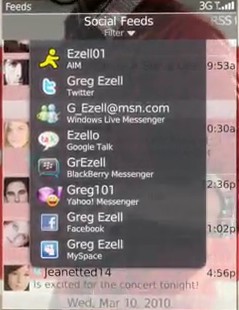
RIM has posted a video showing the features of Blackberry OS 6.0. The OS will bring a redesigned user interface and home screen to all compatible Blackberry phones. At first look it all looks the same, but it has numerous enhancements that help users to access the device features in ease. For instance, there is a universal search for device wide search in contacts, favorites, apps, media, calendar, etc. The home screen of the Blackberry OS 6.0 provide more customization options than any other existing versions. Users can create up to 6 page tabs with their favorites, apps, media shortcuts and fast flip through them using touch. The interface of Blackberry OS 6.0 is more responsive to figure gestures. Improved kinetic scrolling and system wide multi-touch support is another plus point of the new OS. BlackBerry OS 6.0 gives more importance to social media connectivity. The social feed application gives quick access to Twitter, Facebook and Blackberry Messenger, and other updates of favorite contacts.

BlackBerry OS 6.0 social media

BlackBerry OS 6.0 social media

Blackberry OS 6.0 implements a new pop up way to access options in touch enabled smartphones. A pop up window with several options will appear when user taps on any contact, application or media files. This way they can call, send, SMS and use other specific operations of applications very easy. The BlackBerry OS 6.0 will include one click access to media files, a new music player with album arts, fast flip transitions, etc. Photo browser includes improved thumbnail effects with multi-touch and pinch to zoom. Another great attraction of BlackBerry OS 6.0 is the addition of an improved browser based on the web-kit engine. The browser has a better visual design, multi-touch support, tabbed browsing and improved security features. Altogether the new OS is upgrade would make the Blackberry’s in stand with latest smartphone operating systems.

A final build of Blackberry OS 6.0 will be available for download by Q3 of 2010.

.

Videocon tariff plans in kerala

0 comments


Particulars V- Start
MRP in Rs. (inclusive of Service Tax & Education Cess) 49.00
Validity Period (Days) Lifetime*
Talktime (Rs.) 5.00
Pulse Rate (time duration) 60 sec
Local Call (Rs./min.)
Videocon to Videocon1.00
Videocon to Other Mobile1.00
Videocon to Landline1.00
STD (Rs./min.)
Videocon to Videocon1.50
Videocon to Other Mobile1.50
Videocon to Landline1.50
ISD (Rs./min.)
Aus & NZ(Fixed), France(Fixed), Germany(Fixed), Hong Kong, Indonesia, Italy(Fixed), Malaysia, Rest of Europe(Fixed), Singapore, Thailand, UK(Fixed), US, Canada6.40
Bahrain, Bangladesh, China, Kuwait, Oman, Pakistan, Qatar, Saudi Arabia, Srilanka, UAE, UK(Mobile), Bhutan, France(Mobile), Germany(Mobile), Italy(Mobile), Nepal, Rest of Europe(Mobile), Russia(Except 757), Yemen, Zimbabwe(Fixed), Africa9.20
AUS & NZ(Mobile)10.00
Zimbabwe(Mobile), Maldives15.00
Other Countries with Country Code "001", Rest of World I & III50.00
Cook Island, Cuba, Diego Garcia, East Timor, Guinea Bissau, Kiribati, Nauru, Niue Island, Papua N.G., Samoa Western, Sao Tome & Principe, Solomon Isl., Somalia, St. Helena, Tokelau Isl., Tuvalu, USA(001872), Vanuatu, Wallis & Futuna100.00
Inmarsat/ Iridium (Satellite numbers) 550.00
SMS (Rs.)
Local1.00
National 1.50
International 5.00


ISD Rates : Click here for ISD Charges

Terms & Conditions:
*To enjoy the lifetime benefit customer has to do a cumulative recharge of at least Rs. 200 every six months. Validity for lifetime is applicable as per the license period of the service area and is subject to change in case any regulatory and/or licensing condition in future. The validity of our existing license is 24.01.2028 and is extendable for further periods by Government of India.

Nokia Nseries… 10 things you should know By Rhiain

0 comments
The prolific Nseries has introduced us to phones that can double-up as portable computers, cameras and music players. The line-up has been at the forefront of Nokia’s flagship handsets and mobile devices since the Nokia N70 back in 2005. In the past four years we’ve seen the Nokia N86, Nokia N95, Nokia N82, Nokia N97 and most recently the Nokia N900, Nokia N97 mini and Nokia N8. But underneath the hoods are there secrets lurking? Here we take and in-depth look at the Nseries to tell you everything you need to know.


Join us after the jump for an Nseries shaped lesson.

1. The Nokia N95 was the first to introduce GPS and Maps
The Nokia N95 was the first Nokia handset to come sporting Maps and usher in a well-rounded GPS navigation service to mobile devices. It didn’t just store generic country maps, but rather it welcomed the sorts of detailed local maps that we’re used to now. It was the first smartphone to offer voice-commands on the fly and deliver maps for 100 countries. Its GPS talents enabled you to easily plan your route, as well as search and find local points of interest in a fuss-free fashion.

2. OTA software updates are a go on Nseries.
The behemoth of the Nokia N97 can update itself there and then when you’re out and about. It’s simple enough, just enter the code *#0000# into the handset select options and check for updates. If there’s one available go ahead and download away.

If you happen to have another Nseries device follow step one and two and your phone will display a code – write it down and head here for any software updates.

3. The Nokia N800 was the first Nseries device to run Maemo and the Nokia N900 is likely to be the last
If you own a Maemo device it’s set to become a collectors item as the Nokia N900 is likely to be the last handset running the OS. It’s not consigned to the archives just yet as it’ll be joined by Intel’s Moblin to create a super-OS in the form of MeeGo. We’re yet to see any devices running the much talked about OS but it looks set to be a game-changing platform thanks to its ability to easily adapt to different product types – MeeGo will feature on media phones, netbooks, connected TVs, in-vehicle entertainment units and beyond. MeeGo is designed from the ground up to be open in every way. Combining the best of both Maemo and Moblin, and their respective developer communities, it’ll deliver a range of new experiences for users, including changes to computing, communications, multitasking and multimedia. Users will be able to easily move their applications from one device to another and use the same applications on a range of different devices. Hungry for more? Check out the hands-on videos from the folks at Intel.

4. All current Nseries devices come packing Carl Zeiss lenses.
Indeed each and every of of the current Nseries pack comes sporting a Carl Zeiss lens. Renowned for top quality pictorial goodness, the first Zeiss lens Nseries came in the form of the N90 back in 2005 and since then no less than 16 phones have paraded into view with the lenses. Check out this video with Helmut Heier, Sales & Marketing Director at Carl Zeiss for a bit more history on the partnership.

5. Nokia Nseries devices are the most advanced in the Nokia range.
Think of the Nseries as the all-singing, all-dancing mobiles of this world. Launched as a range with multimedia alchemy at its core, the devices soon became a line-up of smartphones packed with the best array of cutting-edge features packed cleverly into a single device. Nseries has welcomed the likes of the Nokia N86, Nokia’s first 8MP camera phone, the N95, one of Nokia’s most popular devices ever, and the desktop-esque experience offered by the N900. And of course most recently the 12-megapixel touting Nokia N8.

6. Watch this Nseries shaped space
The Nokia N900 looks like it will be the last in this range but changes are a foot and it all comes down to the naming conventions and the Nokia N8 heralded that change. Post-the N900, the Nseries will remain the flagship and the most advanced range of products, but we’ll be seeing a new range of numbers following in the footsteps of the N8. Starting from one and climbing to 9, each will signify the range of functionality on offer, and the approximate prices of the devices. So the N900 will be the last in the current line-up but it won’t be the final Nseries by a long shot.

7. The Nseries leading designer is unfortunately (or fortunately?) not Axel Rose.
Although we’re pretty sure that having the lead singer of Guns & Roses would result in some interesting devices, Axel Meyer the Nseries designer is doing a fine job. The creative bod has been behind the Nokia N97 and a bucket of others. Check out these behind the scenes videos with Axel and the whole of the design team for a glimpse of the design process in action.

8. The Nokia N8 is the first Nokia to come toting a 12-megapixel camera and the capability to record HD footage
Nseries is renowned for its pictoral prowess and the fresh-from-the-drawing-board Nokia N8 is no different. It’s the first Nokia to sport a 12-megapixel camera with the most advanced imaging talents ever to appear in a Nokia smartphone, but the firsts don’t end there – it’s also leading the charge when it comes to capturing HD video footage in stunning 720p. As they say seeing is believing cast your eyes on these first sample photos and first sample HD video captured using the Nokia N8.

9. Over 17 million pictures uploaded in Flickr are from Nseries devices. A mind boggling 2.4 billion friends are tagged in Facebook using Nseries devices and .
Can you believe it? A little nugget of trivia for you to take away. We’re off to take some pics and make new friends to get that number doubled pronto.

10. Over nine hours of video is uploaded to YouTube every minute from an Nseries device
And we’re sure there’ll be more to come thanks to the Nokia N8. Check out this latest offering from the behemoth Nokia N8 as it shows-off it’s HD video recording prowess.


Copyright 2010 All Rights Reserved Revolution Two Church theme by Brian Gardner Converted into Blogger Template by Bloganol dot com